
Command and Control (C2) is no longer confined to fixed operations rooms. Today, armed forces deploy mobile command centers (command tents, equipped vehicles, relay drones) and tactical terminals for operators in the field. These tools enable real-time situational awareness, decentralized coordination, and increased responsiveness to threats.
In this context, solutions such as KAPTREK PRO PILOT DEFENSE are emerging as intelligent tactical terminals, designed to integrate C2/C4ISR data flows and provide operators with information superiority directly on their wrist.
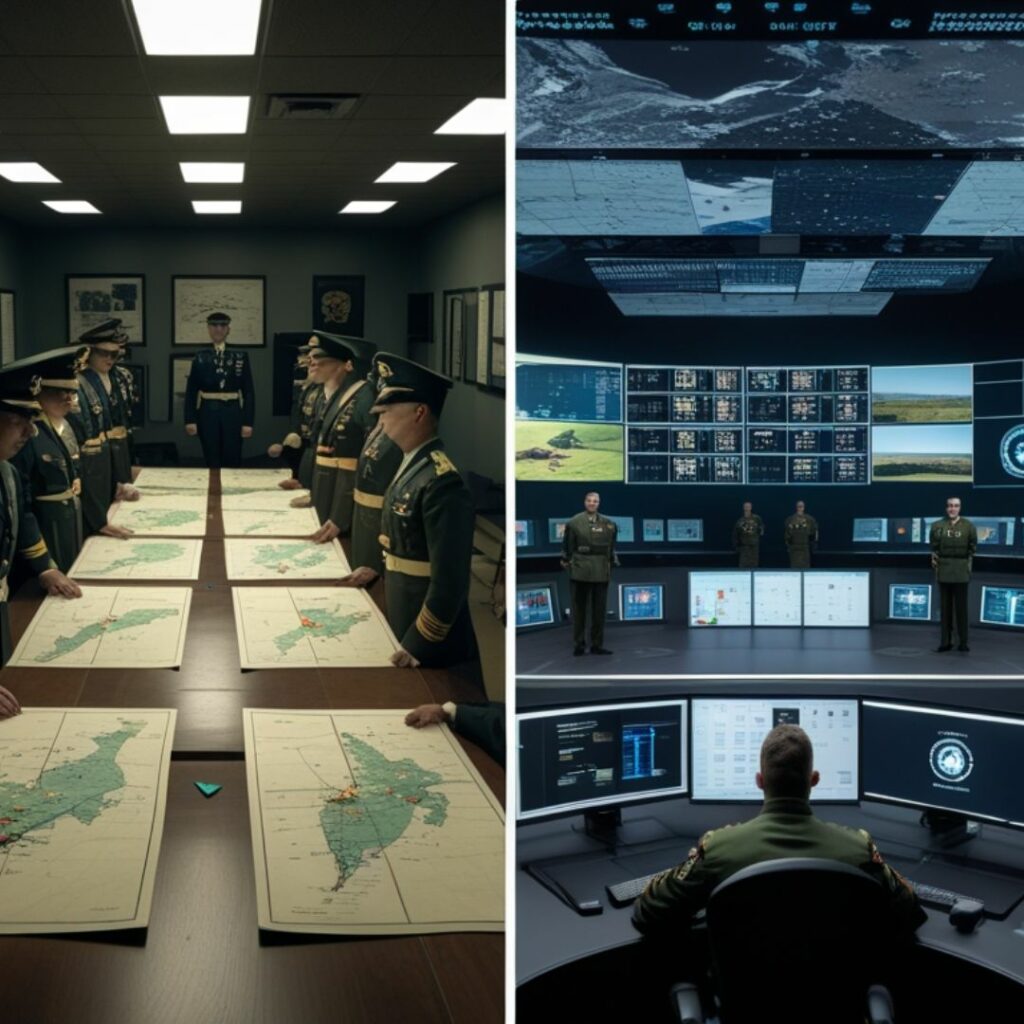
Evolution of C2 deployment: from fixed command rooms to mobile command centers
Traditional command centers
Historically, C2 relied on fixed infrastructures:
-
Rooms equipped with paper maps, situation boards, and analog radios.
-
Critical delays: slow transmission of orders and a high risk of information becoming outdated.
-
Example: during World War II, strategic decisions could take several hours to reach frontline units.
The era of mobile command centers and operational tents
With digitalization, armed forces have adopted deployable solutions:
-
Command tents: equipped with servers, touchscreens, and satellite links.
-
C2 vehicles: trucks or armored vehicles converted into mobile control centers (e.g., the French SICS, the U.S. JADC2).
-
Relay drones: used to extend network coverage in hostile environments.
Advantages:
✅ Reduced delays: instant transmission of orders and data.
✅ Flexibility: adaptation to mobile missions (e.g., special operations, rapid deployments).
✅ Resilience: system redundancy to prevent critical failures.
Tactical terminals: within operators’ reach
The need for mobility and immediacy
Mobile command centers are no longer enough: operators in the field need real-time access to C2/C4ISR data without relying on a fixed station. This is where tactical terminals come into play:
-
Rugged smartwatches and tablets: display maps, alerts, and unit geolocation.
-
C4ISR data integration: merging information from drones, sensors, and intelligence into a single interface.
-
Secure communication: walkie-talkie, encrypted messaging, and coordinate transmission.
KAPTREK PRO PILOT DEFENSE: the next-generation tactical terminal
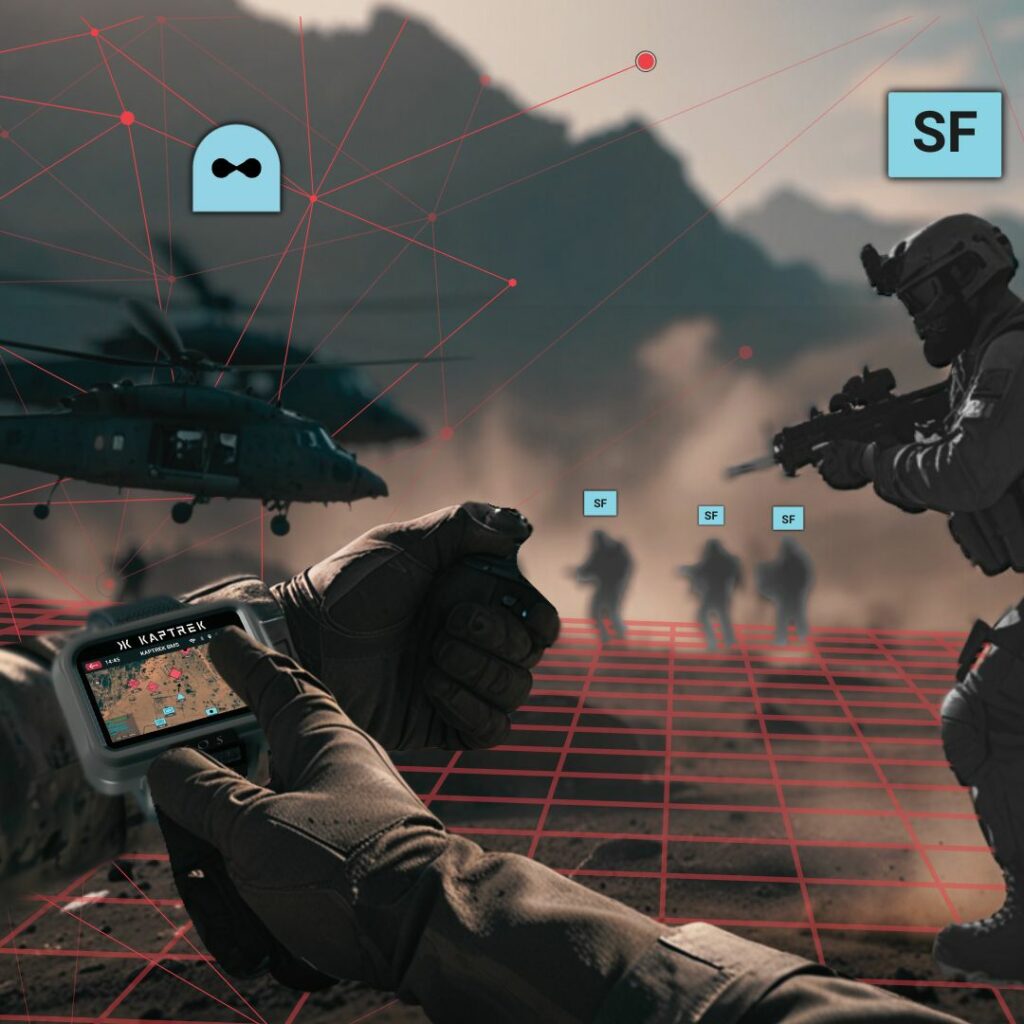
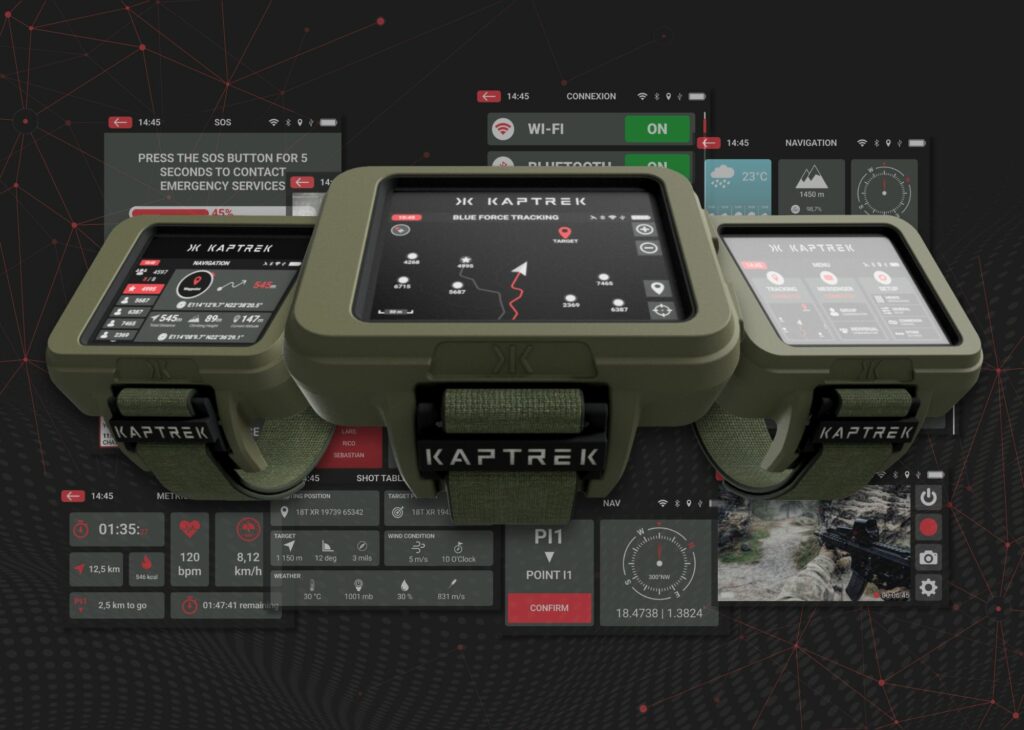
Designed for operators on mission, the KAPTREK PRO PILOT DEFENSE smartwatch meets the demands of modern C2:
-
Native C4ISR integration:
-
Receive tactical alerts (threats, orders, enemy positions).
-
Share geolocation with friendly units (Blue Force Tracking compatible).
-
Remote control: operate drones or cameras (GoPro) for instant reconnaissance.
-
-
Durability and autonomy:
-
IP67/IK08 standards for extreme environments.
-
Long-lasting battery and fast charging (secure pogo pin connector).
-
-
Interoperability:
-
Compliant with current standards.
-
Sovereign OS (Linux-based) for full data control.
-
Use cases:
-
Special operations: discreet coordination between dispersed teams.
-
Rescue missions: transmit victim locations and obstacles.
-
Area surveillance: real-time alerts via connected sensors.
“With KAPTREK, an operator can receive a drone alert, locate a threat, and transmit the coordinates to their unit in under 30 seconds — without leaving their position.” – Field user testimonial.
C2/C4ISR Deployment: Challenges and Solutions for Modern Forces
Cybersecurity and terminal resilience
Risks: communication hacking, GPS jamming, denial-of-service attacks.
Solutions:
-
End-to-end encryption (e.g., AES-256 protocols).
-
Decentralized architectures: no single point of failure.
-
Sovereign terminals: like KAPTREK, designed to withstand cyberattacks.
Interoperability and standardization
Challenges:
-
Multiple systems (NATO, EU, national).
-
Need for common standards for data sharing.
-
Example: France’s SCORPION program unifies communications between tanks, infantry, and drones.
Operator training and adoption
Issue: avoid cognitive overload from overly complex interfaces.
KAPTREK solution:
-
Intuitive design: adaptive touchscreen, simplified menus.
-
Integrated training: simulation modules to master C4ISR functionalities.
C2/C4ISR Deployment: Challenges and Solutions for Modern Forces
The deployment of C2/C4ISR in the field has evolved:
-
From fixed command rooms → to mobile command centers (tents, vehicles).
-
From analog radios → to intelligent tactical terminals (such as KAPTREK).
Keys to success:
✔ Immediacy: real-time data for rapid decision-making.
✔ Mobility: lightweight, rugged tools for operators on the move.
✔ Security: protection against cyber threats and interference.
KAPTREK PRO PILOT DEFENSE embodies this revolution: a tactical terminal that brings the power of C4ISR directly to soldiers’ wrists, delivering uncompromised operational superiority.
Why consider KAPTREK PRO PILOT?
-
Time savings: centralized access to all critical information, reducing reaction times.
-
Improved coordination: secure, seamless communication between teams, minimizing risks from fragmented data.
-
Enhanced security: optimized protection of personnel and infrastructure through better-informed, synchronized responses.
Discover KAPTREK PRO PILOT in action:
Useful Links:
Basic Definitions
-
Wikipédia (FR): https://fr.wikipedia.org/wiki/C4ISR – Detailed explanation of the acronym and its components (Command, Control, Communications, Computers, Intelligence, Surveillance, Reconnaissance).
-
Wikipedia (EN): https://en.wikipedia.org/wiki/C4ISR – International overview with history and NATO usage.
Specialized Articles
-
Kaptrek: https://kaptrek.com/kaptrek-pro-pilot/systemes-de-commandement-c2-c3-c4-c4isr-vers-un-commandement-connecte-et-agile/ – Evolution from C2 to C4ISR and modern challenges like real-time coordination.
-
Défense Nationale: https://www.defnat.com/e-RDN/vue-article.php?carticle=2869 – “C4ISR: arming with intelligence”, focusing on OODA integration and unified architectures.
-
Canadian Army: https://www.canada.ca/fr/armee/services/journal-armee-canadienne/articles/2024/20-2-kool.html – Tactical analysis of C4ISR, emphasizing decentralization and resilience.
Industry Studies
-
Assured Systems: https://www.assured-systems.com/fr/etudes-de-cas/ordinateur-de-mission-de-frappe-conjointe-c4isr/ – Use cases for joint missions and information superiority.
-
Milrack: https://milrack.com/what-is-c4isr/ – Practical configurations (mobile and naval command centers) and VR innovations.
-
Defense One: https://www.defenseone.com/insights/cards/c4isr-military-nervous-system/ – C4ISR as the military “nervous system”, integrating multi-sensor data.